A model can be accurate, packaged, tested, containerized, and reachable through an API without yet being part of a reliable system. Model deployment proves that software can accept input and return a prediction. A production system must do more: it must deliver useful decisions repeatedly, under changing conditions, while failures are detected, contained, and corrected.
This distinction marks the starting point of this guide.
The preceding Model Deployment guide ended with a validated model service. That service is the foundation used here—not the final product. From Models to Systems begins after deployment and asks what must surround the service so that people and organizations can depend on it.
Learning objectives
By the end of this chapter, you should be able to:
distinguish a deployed model service from an operational decision system;
explain why one successful API request is necessary but insufficient evidence of production reliability;
identify the major responsibilities surrounding a model in production;
separate model quality, service quality, system quality, and decision quality;
describe the feedback loop that allows a system to learn after deployment; and
recognize the shared responsibilities of data science, software engineering, operations, governance, and domain teams.
The deployment boundary
Model development asks whether a model can learn a useful relationship from data. Model deployment asks whether the fitted pipeline can be packaged and served consistently. Systems engineering asks whether the complete pathway from incoming data to human or automated action continues to work in the real world.
These are related but different forms of evidence.
Stage
Central question
Typical evidence
Model development
Does the model have useful predictive performance?
It does not establish how the service behaves during traffic spikes, malformed upstream data, network failures, dependency outages, model drift, delayed outcomes, security events, or inappropriate human use.
The key boundary
Model Deployment ends with a packaged, validated, tested, and containerized model service. From Models to Systems starts with that service and builds the operational, learning, governance, and decision infrastructure around it.
A service is one component of a system
An API endpoint is visible because it is easy to call and test. In production, however, it is only one component in a longer chain.
Code
flowchart TD
    A["Source data"] --> B["Validation and features"]
    B --> C["Model service"]
    C --> D["Decision workflow"]
    D --> E["Action and outcome"]
    E --> F["Monitoring and feedback"]
    F --> B
flowchart TD
    A["Source data"] --> B["Validation and features"]
    B --> C["Model service"]
    C --> D["Decision workflow"]
    D --> E["Action and outcome"]
    E --> F["Monitoring and feedback"]
    F --> B
Each connection introduces assumptions:
source data arrive on time and retain their expected meaning;
feature transformations match those used during training;
the service has enough compute and memory;
downstream applications interpret the response correctly;
decision rules use the prediction appropriately;
people understand when to accept, question, or override a recommendation; and
outcomes are captured so performance and impact can be assessed.
If any assumption fails, the model may remain technically correct while the system produces unreliable or harmful results.
Four levels of quality
It helps to evaluate a model-enabled system at four levels rather than collapsing everything into a single accuracy score.
Model quality
Model quality concerns the statistical behavior of the trained artifact. Relevant questions include:
How well does it discriminate or estimate on unseen data?
Is it calibrated for the intended use?
Which groups or cases experience the largest errors?
Are the training data sufficiently representative?
These questions remain important after deployment, but they do not cover service availability or operational use.
Service quality
Service quality concerns the deployed application:
Does it validate requests and responses?
Is latency acceptable?
Is the service available when needed?
Can it recover from failure?
Does the deployed artifact match the approved version?
System quality
System quality concerns the complete technical pathway:
Are upstream data and downstream dependencies healthy?
Can the system handle realistic load and bursts?
Are logs, metrics, traces, and alerts sufficient for diagnosis?
Can releases be rolled back safely?
Are security controls and access boundaries enforced?
Decision quality
Decision quality concerns what happens because the system exists:
Is the prediction connected to a clearly defined decision?
Who is accountable for the resulting action?
Can a person contest or override the recommendation where appropriate?
Are benefits, costs, and unintended effects measured?
Does the workflow remain useful as conditions change?
These levels depend on one another, but success at a lower level does not guarantee success at a higher one. A highly accurate model can be unavailable. A reliable API can receive stale data. A technically healthy system can encourage a poor decision.
Why one successful request is not enough
Suppose a containerized prediction service receives a valid request and returns HTTP 200 with the expected schema. This confirms several valuable facts: the container starts, the model loads, validation succeeds, preprocessing runs, inference completes, and a response is serialized.
Now consider what the same test does not reveal.
Reliability over repeated requests
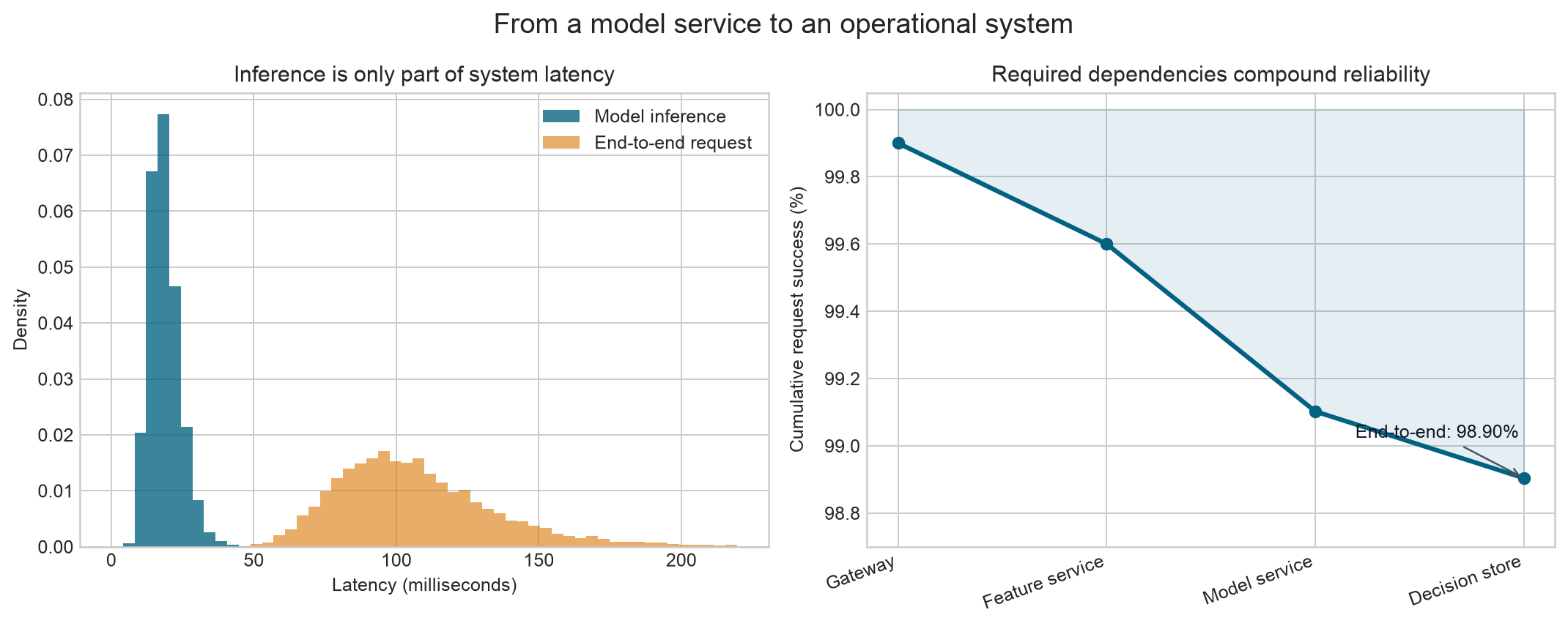
A single success says little about failure rates across thousands of requests. Even components that are individually reliable can reduce end-to-end reliability when every component must succeed.
If four required components have availabilities of \(a_1, a_2, a_3,\) and \(a_4\), a simplified estimate of end-to-end availability is:
\[
A_{system} = \prod_{i=1}^{4} a_i
\]
This calculation assumes independent failures, which is often optimistic. Shared infrastructure, traffic surges, or a faulty release can cause correlated failures.
Latency under realistic load
Inference may take only a few milliseconds in isolation, while queueing, network transfer, feature retrieval, authentication, logging, and downstream calls dominate the response time. Average latency can also hide a slow tail, so teams commonly examine percentiles such as p50, p95, and p99.
Change over time
The first request occurs at one moment. Production continues while data distributions, user behavior, dependencies, code, infrastructure, policies, and objectives change. A system therefore needs monitoring and controlled change—not just a correct initial release.
Recovery after failure
Testing the healthy path does not show whether an alert reaches the right person, a rollback works, lost requests can be recovered, or the team can explain an incident. Reliability includes the ability to detect and recover from failure.
A small reliability demonstration
The Chapter 01 script simulates the difference between isolated model latency and end-to-end system latency. It also shows how the reliability of required dependencies compounds across a request pathway.
The program writes summary metrics to results/01-service-vs-system-summary.csv and the figure to results/figures/01-service-vs-system-reliability.png.
Figure 2.1: A simulation comparing isolated model latency with end-to-end system latency and showing how reliability compounds across required components.
The exact simulated values are illustrative, not production targets. The important pattern is structural: the model is only part of the latency budget, and every required dependency affects the probability of completing a request successfully.
Use measurements, not the demonstration values
Real service-level objectives should follow the needs and risks of the actual decision workflow. A batch report needed by the next morning and an interactive clinical alert have very different latency, availability, and recovery requirements.
Production is a continuing process
Deployment is an event. Operation is a continuing process.
Once a model is released, teams must repeatedly observe the system, compare its behavior with expectations, diagnose deviations, and decide whether to change code, infrastructure, data, the model, or the surrounding workflow.
Code
flowchart LR
    A["Release"] --> B["Observe"]
    B --> C["Evaluate"]
    C --> D["Improve"]
    D --> A
flowchart LR
    A["Release"] --> B["Observe"]
    B --> C["Evaluate"]
    C --> D["Improve"]
    D --> A
This loop has two related forms:
the operational loop detects failures, performance degradation, capacity problems, and incidents; and
the learning loop captures outcomes, evaluates real-world model behavior, and determines whether data, features, thresholds, or models should change.
Fast operational signals such as errors and latency may be available immediately. Decision outcomes may arrive days or months later. The system must preserve enough context to connect a prediction with its eventual outcome without violating privacy, security, or retention requirements.
DevOps, MLOps, and decision systems
The terms in this guide overlap, so clear working definitions are useful.
DevOps connects software development and operations through automation, shared responsibility, reproducible environments, continuous integration, controlled delivery, observability, and rapid recovery.
MLOps extends these practices to the changing data and model artifacts that influence predictions. It adds concerns such as data validation, experiment and model lineage, model evaluation gates, drift monitoring, retraining, and controlled promotion.
Decision systems place the technical system inside its real organizational and human context. They define how a prediction becomes an action, who has authority, what evidence is retained, how exceptions are handled, and whether outcomes remain beneficial and responsible.
They are not competing labels. In a mature model-enabled system, they form nested concerns:
The boundaries vary by organization. The principle does not: responsibilities must be explicit, observable, and connected. A task that belongs to “everyone” but has no accountable owner is likely to be missed.
A systems readiness checklist
Before calling a deployed model a production system, ask whether the team can answer the following questions with evidence:
Purpose: What decision does the system support, for whom, and under what constraints?
Inputs: How are schema, freshness, completeness, and semantic meaning checked?
Service: What latency, availability, and correctness objectives apply?
Delivery: How are changes tested, approved, released, and rolled back?
Observation: Which metrics, logs, traces, and alerts reveal failure?
Scale: What load can the system handle, and what happens beyond that limit?
Learning: How are outcomes linked to predictions and evaluated over time?
Governance: Who owns each risk, model version, approval, and exception?
Human use: How are recommendations explained, reviewed, overridden, or contested?
Recovery: Who responds to incidents, and how is service restored safely?
The later chapters turn these questions into practical workflows. The objective is not to add operational ceremony around a model. It is to create evidence that the entire system remains dependable and useful.
Chapter summary
Model deployment establishes that a trained pipeline can be packaged and served. Systems work begins when that service must operate repeatedly within a larger technical, organizational, and human pathway.
The main lessons are:
one correct API response validates a prediction pathway, not sustained production readiness;
model, service, system, and decision quality are distinct levels of evidence;
latency and reliability depend on the complete chain of required components;
production requires both an operational loop and a learning loop;
DevOps, MLOps, and decision-system practices address complementary layers; and
dependable systems require explicit ownership across technical, governance, domain, and user perspectives.
Chapter 02 introduces the continuous case study and maps these concerns onto a concrete system architecture.
Review questions
What does a successful HTTP 200 prediction response prove, and what does it leave unproven?
Give one example each of a model-quality, service-quality, system-quality, and decision-quality failure.
Why can end-to-end availability be lower than the availability of every individual component?
How does an operational feedback loop differ from a model learning loop?
Which responsibilities in the readiness checklist require domain or decision owners rather than only technical teams?
Practical exercise
Choose a model service you have built or can imagine. Write a one-page system boundary description containing:
the decision the model supports;
the source and expected freshness of each input;
the components required between input and action;
three observable failure modes;
the person or team responsible for each failure mode; and
the outcome signal that would reveal whether the system is genuinely useful.
Then run the Chapter 01 simulation and inspect the summary CSV. Change one component availability or latency distribution in the script and explain how that change affects the end-to-end result.