DevOps for Model Systems
DevOps for Model Systems
Deploying a model service once proves that the prediction pathway can run. Operating that service repeatedly requires a broader discipline: every change must be understandable, testable, reproducible, reviewable, and recoverable.
This chapter introduces DevOps as the operating foundation for model systems. The focus is not a particular cloud platform. It is the set of working practices that turns a locally functioning service into software that a team can change safely.
By the end of the chapter, you will be able to:
- distinguish model deployment from DevOps and MLOps;
- explain how version control, automation, environments, and feedback work together;
- define a practical change pathway for the guide’s model service;
- run a local quality gate before submitting a change; and
- identify which failures should stop a release early.
From a deployed model to an operated system
The previous guide ended with a packaged, validated, tested, and containerized model service. That is the correct starting point for this guide, but it is not yet an operating model system.
A production change can affect several connected assets:
- application code;
- model artifacts;
- preprocessing logic;
- input and output schemas;
- dependencies and container images;
- configuration;
- infrastructure definitions; and
- tests, dashboards, and operating documentation.
These assets do not always change together. A dependency update can break the service even when the model is unchanged. A schema change can invalidate clients even when predictions remain accurate. A model replacement can satisfy software tests while producing unacceptable real-world behavior.
DevOps provides the practices for controlling software and operational change. MLOps extends those practices to the additional uncertainty introduced by data, models, experiments, and performance in use.
| Concern | Model deployment | DevOps | MLOps |
|---|---|---|---|
| Primary question | Can the model be packaged and served? | Can the service be changed and operated safely? | Can data and model behavior also be governed over time? |
| Main assets | Model pipeline, API, container | Code, configuration, infrastructure, releases | Data, features, experiments, models, lineage |
| Typical evidence | Valid request and response, API tests | Repeatable builds, automated checks, deployment records | Data validation, model evaluation, drift and retraining evidence |
| Failure horizon | Packaging or request time | Build, release, deployment, or runtime | Training time and changing real-world conditions |
The boundaries are useful, but the disciplines cooperate. A mature model system needs all three.
DevOps is a feedback system
DevOps is sometimes reduced to a list of tools. Tools matter, but the more durable idea is a short, observable feedback loop:
- make a small, traceable change;
- validate it as early as possible;
- package the same tested revision;
- release it through controlled environments;
- observe technical and user-facing outcomes; and
- feed operational evidence into the next change.
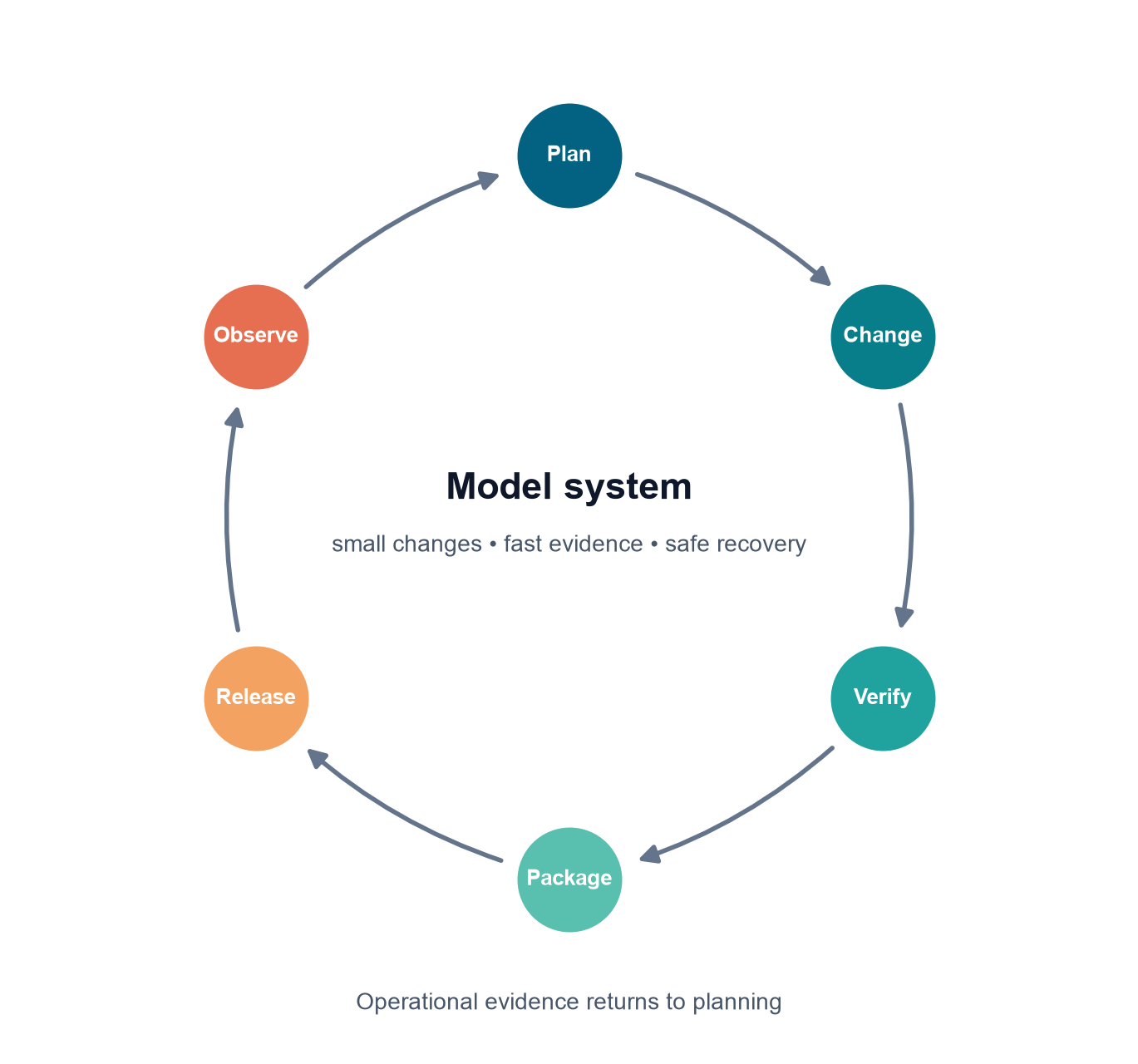
The loop is valuable because it reduces the distance between an action and evidence about its consequences. Large batches, manual handoffs, and inconsistent environments lengthen that distance and make failures harder to diagnose.
The operating principles
Version everything required to reproduce a release
Git should record source code, tests, dependency declarations, container definitions, configuration templates, automation, and documentation. Each release should map to an immutable commit identifier.
Do not commit credentials, tokens, local virtual environments, caches, or large generated artifacts merely because they exist in the project directory. Model artifacts require an explicit lifecycle strategy; later chapters separate their logical version from source-code history.
For the case-study service, a change is traceable when the team can answer:
- Which commit produced the running service?
- Which model version does it load?
- Which configuration was applied?
- Which checks passed before release?
- Who approved or initiated the change?
Prefer small, reversible changes
Small changes are easier to review, test, deploy, and diagnose. A commit should represent one coherent purpose. A release should have a defined rollback or roll-forward path before it reaches production.
Reversibility does not mean every action can be undone automatically. Database migrations, schema changes, and externally visible predictions may have lasting effects. It means the operational consequence has been considered and a recovery action is documented.
Automate repeatable checks
Automation makes evidence consistent. It should begin locally, then run again in continuous integration. Useful early checks include:
- required repository files exist;
- Python source compiles;
- tests pass;
- dependency metadata is present;
- the container definition exists; and
- generated outputs are not mistaken for source inputs.
Automation is not a substitute for judgment. It converts known expectations into repeatable gates so that human review can focus on design, risk, and meaning.
Keep environments explicit
Development, test, staging, and production serve different purposes. They should differ through controlled configuration—not through undocumented manual repair.
| Environment | Main purpose | Suitable evidence |
|---|---|---|
| Development | Fast local iteration | Focused tests, linting, local service checks |
| Test/CI | Independent automated validation | Clean install, full test suite, build result |
| Staging | Production-like integration | Deployment, smoke, compatibility, and rollback tests |
| Production | Real service delivery | Health, latency, error, resource, and outcome signals |
Configuration values should enter through documented environment variables or managed configuration. Secrets should come from a secret-management mechanism and must never be embedded in source code or a container image.
Make work observable
Every automated stage should return a clear status and retain enough context for diagnosis. A failed command with no identifiable revision, environment, or log is not useful feedback.
At minimum, operational records should connect:
commit -> build -> image -> deployment -> runtime evidenceModel systems later extend that chain:
data -> training run -> evaluation -> model version -> deployment -> prediction evidenceA change pathway for the case-study service
Consider a small change: adding a response field named model_version to the prediction endpoint.
The field is operationally helpful, but the change crosses multiple layers:
- update the response schema;
- update the endpoint implementation;
- update unit and API tests;
- run the local quality gate;
- commit the coherent change;
- let CI repeat the checks in a clean environment;
- build an image tagged with the commit identifier;
- deploy to staging and run a smoke test;
- promote the verified image rather than rebuilding it; and
- observe errors and client compatibility after production release.
This pathway illustrates an important rule: build once, promote the same artifact. Rebuilding for each environment can introduce dependency or packaging differences after testing has already passed.
Practical: run a local quality gate
The repository includes a small Python checker and a Bash wrapper:
bash scripts/bash/03-run-devops-checks.shThe wrapper calls:
python scripts/python/03-check-repository.py --project-root .The checker performs four deliberately simple gates:
- verifies expected project files and directories;
- compiles Python files without executing the application;
- runs
pytestwhen tests are present; and - writes a machine-readable report to
results/03-devops-check-report.json.
Example terminal output:
[PASS] repository_structure: required paths are present
[PASS] python_syntax: Python files compiled successfully
[PASS] tests: 12 tests passed
[PASS] dependency_metadata: requirements.txt found
Report written to results/03-devops-check-report.json
Overall status: PASS
The command exits with status 1 when a required gate fails. That behavior is essential: CI systems use exit status to decide whether later work, such as building or deploying an image, is allowed to continue.
Inspect the report
The report records the time, project root, overall status, and each gate result. It is evidence from a particular run, not source code. It therefore belongs under results/ and can normally be regenerated.
{
  "overall_status": "pass",
  "checks": [
    {
      "name": "repository_structure",
      "status": "pass",
      "details": "required paths are present"
    }
  ]
}
Generate the chapter figure
The workflow figure is reproducible:
python scripts/python/03-generate-devops-workflow-figure.pyThe script writes results/figures/03-devops-feedback-loop.png.
Designing useful gates
A gate should protect a meaningful property and return an actionable result.
| Weak gate | Stronger gate |
|---|---|
| “The file exists.” | “The declared model loads and produces a schema-valid response.” |
| “The container built.” | “The immutable image passed health and prediction smoke tests.” |
| “Accuracy is above 0.80.” | “The approved evaluation metrics and subgroup constraints pass on versioned data.” |
| “Deployment completed.” | “The target revision is healthy and key service indicators remain within limits.” |
Not every check belongs in the local script. Fast deterministic checks should run early. Slower integration, security, load, and production checks belong at later stages where the necessary environment exists.
The sequence should fail fast:
structure -> syntax -> unit tests -> integration tests -> build -> security checks -> staging -> productionPassing an early gate never guarantees that later gates will pass. It only establishes that a defined set of risks has been checked.
Common failure modes
Automation that depends on one developer’s machine
If a script relies on an undeclared package, an absolute local path, or manually exported variables, it is not reproducible. Test automation in a clean environment and keep dependencies explicit.
Treating a successful build as a successful release
A build proves that an artifact was created. It does not prove that the artifact starts, serves valid predictions, integrates with dependencies, or behaves acceptably under real traffic.
Mutable release identifiers
Tags such as latest can move and cannot uniquely identify what is running. Human-friendly tags may be retained, but releases should also use immutable identifiers such as a commit SHA or image digest.
Manual production fixes
Changing a running environment without recording the change creates configuration drift. Apply durable fixes through the same reviewed and automated pathway used for other changes.
Ignoring model-specific risk
Conventional software checks cannot determine whether input data has shifted or whether predictions remain useful and fair. Those concerns require the monitoring, feedback, and lifecycle practices developed later in this guide.
Chapter checklist
Before moving to continuous integration and delivery, confirm that the project has:
- a version-controlled and reviewable change process;
- explicit dependency and configuration declarations;
- fast local checks with meaningful exit codes;
- tests separated from generated evidence;
- immutable links among commits, builds, and releases;
- distinct development, test, staging, and production purposes; and
- a documented recovery expectation for deployments.
Key takeaways
- Deployment demonstrates that a model can be served; DevOps governs how the service is changed and operated.
- DevOps is a feedback system built from traceability, automation, explicit environments, observability, and recovery.
- A model system must track more than code because data, model artifacts, schemas, and configuration can change independently.
- Local quality gates provide the first layer of fast feedback and should be repeated in a clean CI environment.
- Passing a build is one piece of release evidence, not proof of production readiness.
In the next chapter, these local practices become a continuous integration and delivery pipeline.